Dora Charalampaki talks to Niki Stylianou about her Visual Language
In the framework of the exhibition FORMA I Objects and Materials in Dialogue
21 July 2026
My dear Dora,
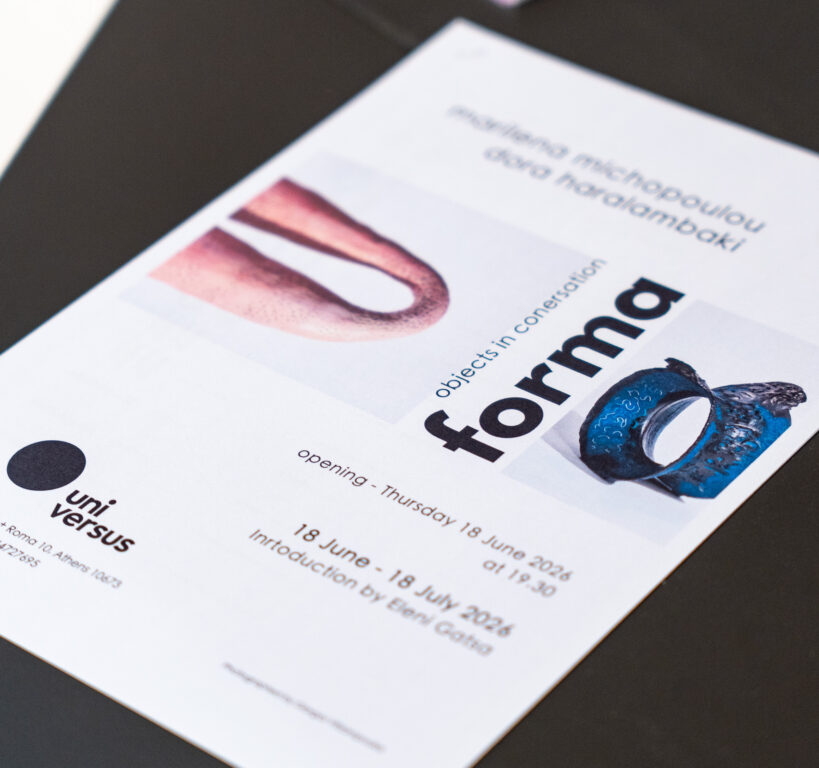
I have known you for many years. Your trajectory, the symbols that haunt you, your love for materials, and your obsession with color. Nevertheless, I would like to hear you talk about all of this. So that our audience can also understand how you arrived at this body of work and this collaboration with Marilena Michopoulou within the context of the exhibition FORMA – Objects in Conversation.
Ceramics is one of the most ancient human practices. Would you like to tell us about your own relationship with clay? What made you choose it as your primary medium of expression, and what can it convey for you that other materials struggle to articulate? Do you feel that you are conversing with a long tradition, or that you are building a personal, contemporary mythology?
My own relationship with clay goes back many years, sparked by my desire to move away from the canvas at a time when I was expressing myself visually through painting. I won’t deny, of course, that since I was a little girl, I was magnetized by the use of ceramic vessels and the beauty of the form and texture achieved by various great ceramicists. So, when I got my hands in the mud and truly grounded myself with something very primitive within me, I felt that right there I could find something fundamentally expressive. It is a cliché to speak of the material’s plasticity, but what truly fascinates me is that it accepts, imprints, and carries the fingerprint! For years, for many years… Thus, in my mind, it records and extends time. Add to this the fact that I am not a fan of perfection on any level, and the material itself welcomes imperfection and embraces the mistake—which is entirely up to you to keep and decide to what extent it will ultimately remain a mistake! Another very important aspect of my relationship with the material is that it underscores the fragility of existence; hard, yet fragile at the same time. So, naturally, I am conversing with a long tradition, since
mud is earth and water, carrying centuries of memories—but with the air that dries it in my present environment and the fire that burns everything during the firing process for a new beginning! FASCINATING!
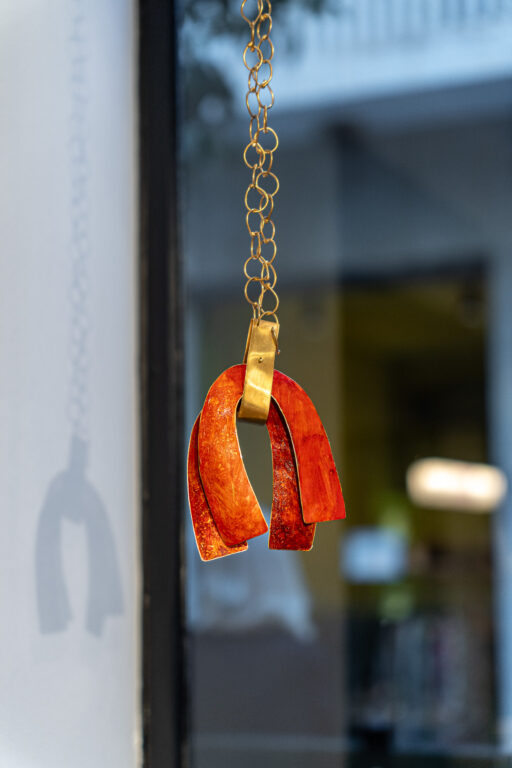
In your work, ceramics often meet metal. What attracts you to this dialogue of materials? How do fragility and resilience, the organic and the industrial, coexist within your creative process?
Fired ceramic is eternal yet breaks with a single blow. Metal bends, rusts, but withstands pressure and time. Both materials are transformed by the ordeal of fire, by high temperatures, but in opposite ways. Clay hardens in the fire, whereas metal melts. This coexistence mirrors human nature itself. We are simultaneously vulnerable (clay) and resilient (metal). The artwork ceases to be merely an object and becomes a commentary on humanity’s relationship with nature and industry. With the “here and now” and everything related to the bubble I willingly enter during the evolution of an idea.

The forms you create seem to carry a language of their own. Are there symbols, shapes, or images that return again and again in your work? And what do you believe they continue to ask of you or reveal to you over time?
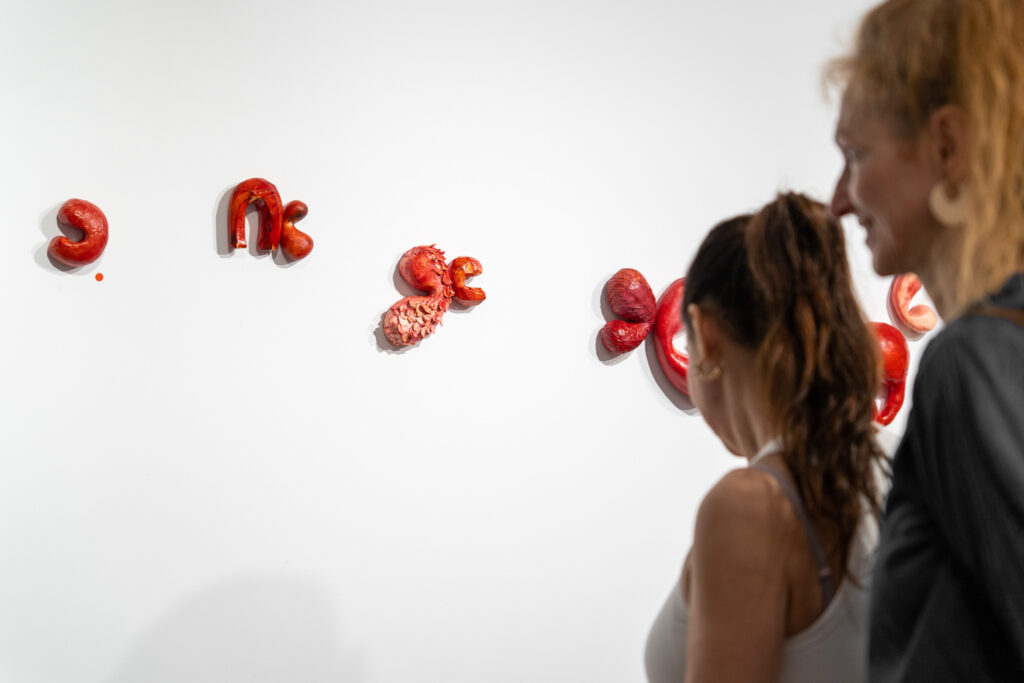
Unresolved issues, internal ones. Visceral, I call them. Femininity, with a set of traits, behaviors, social roles, and forms of expression traditionally associated with girls and women. With this multidimensional concept, shaped by biology, society, culture, as well as the personal identity of each individual. Thus, my work is almost always permeated by embryonic shapes, umbilical cords, and reproductive symbols. They always ask for and reveal the same thing to me. A nature stronger than any personality…
Color is an integral part of your work, and in the current exhibition, red has a particularly strong presence. How did this relationship with it emerge? Does it function for you as a color, a symbol, an emotion, or a mode of storytelling?
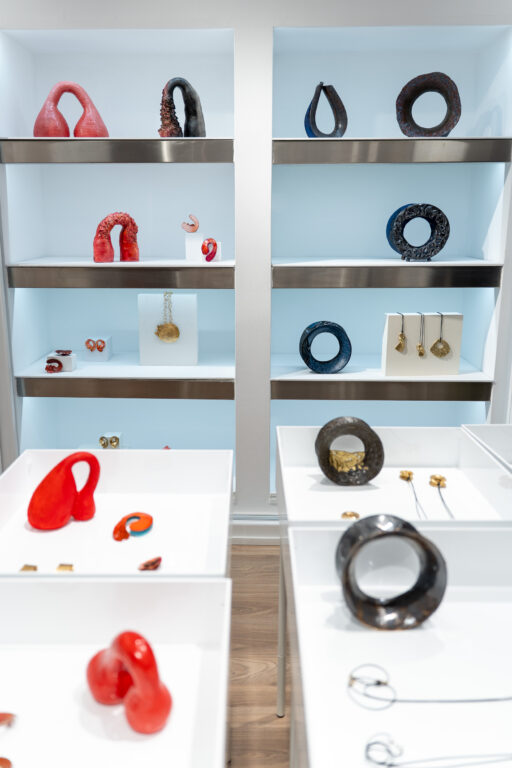
The choice of the color red in this specific exhibition is not merely an aesthetic decision, but a living, pulsating organism that permeates the works. I am deeply interested in the study of tonality within a color that is not JUST one. In ceramics, for instance, red is the color of creation itself: it is the fire of the kiln, the incandescent metal, and the primordial color of terracotta (baked earth). In my own visual language, red operates simultaneously on four different levels:

- As materiality and color The challenge of firing: In ceramic glazes, a pure, brilliant red is one of the most difficult colors to achieve, as it requires absolute control over temperature and oxides. Visual weight: It has the property of magnetizing the gaze, creating an intense dialogue with the cold, industrial hues of the metal.
- As emotion The intensity of extremes: Red hides nothing; it expresses passion, love, and vital drive, but simultaneously anger, pain, or a sense of urgency. It brings the internal temperature of the works to the surface, making the cold matter (clay and iron) appear as if it is burning from the inside out.
- As a symbol The archetype of blood: It symbolizes life, mortality, as well as the lineage that connects us to our ancestors. Feminine power: It is inextricably linked to fertility, creation, and the revolutionary nature of contemporary femininity that courageously claims its space.
- As a mode of storytelling Ariadne’s thread: Within the exhibition space, red acts as connective tissue. It guides the viewer from one piece to the next, unraveling a story of transformation.

Is there a memory, sensation, or image that frequently returns while you work? Something that, consciously or unconsciously, runs through your work and fuels the creative process?
I believe I have already answered this.
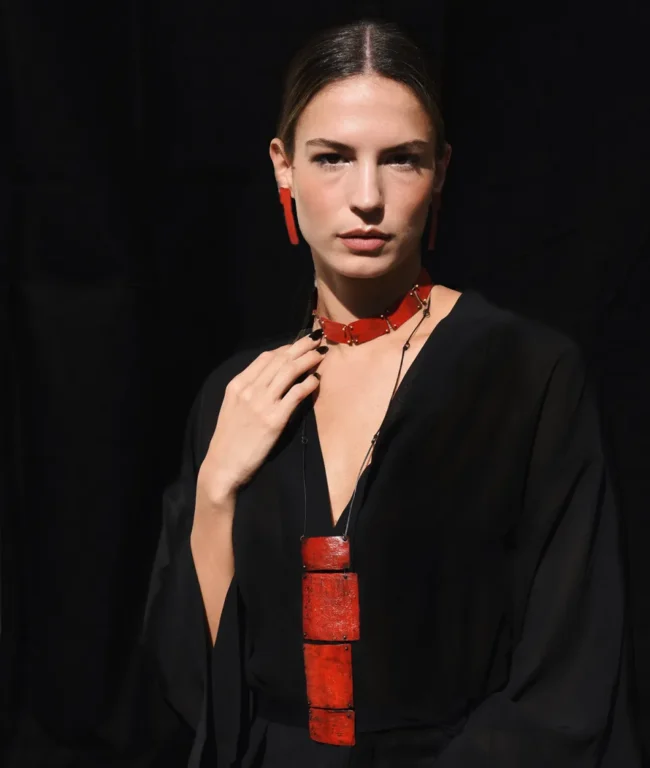
Your works navigate the boundaries between object, sculpture, and jewelry. What would you like the viewer to feel or discover upon encountering them? And what changes when a piece is worn and becomes part of someone else’s body?
My work abolishes the boundaries between object, sculpture, and jewelry, inviting the viewer to discover the detail, the contrast of textures, and the hidden history behind the synthesis of clay and metal. When the piece transitions from the pedestal to the body, it ceases to be static and is activated through movement, transforming the wearer into a living part of the artistic act. By absorbing the temperature of the skin, the cold matter metamorphoses into an organic “second skin”—a contemporary talisman that externalizes the power, the fragility, and the personal mythology of each individual.
Do you believe that objects possess a life of their own? And if so, when does this life begin: when you create them, when you exhibit them, or when they pass into someone else’s hands?
Objects do possess a life of their own, which is born in the studio through the energy of the creator, becomes autonomous in the exhibition when it meets the public’s gaze, and is fulfilled when it passes into the hands of its new owner. By wearing the piece on the body, the person transfers their own temperature and experiences to it, transforming static matter into a living, contemporary talisman that continues to write its own history over time.
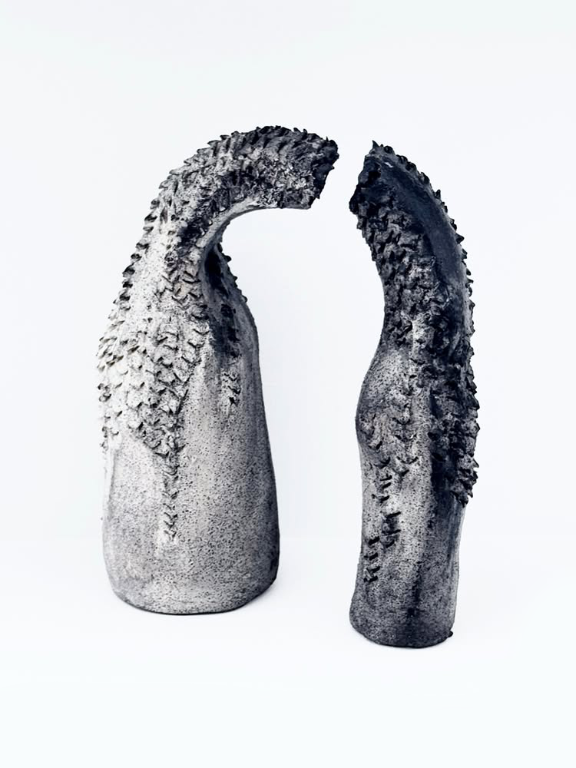
How was the idea of this collaboration with Marilena Michopoulou born? What did you recognize in her work that made you want to engage in a dialogue with it? And in what way does the title FORMA – Objects in Conversationcapture this encounter?
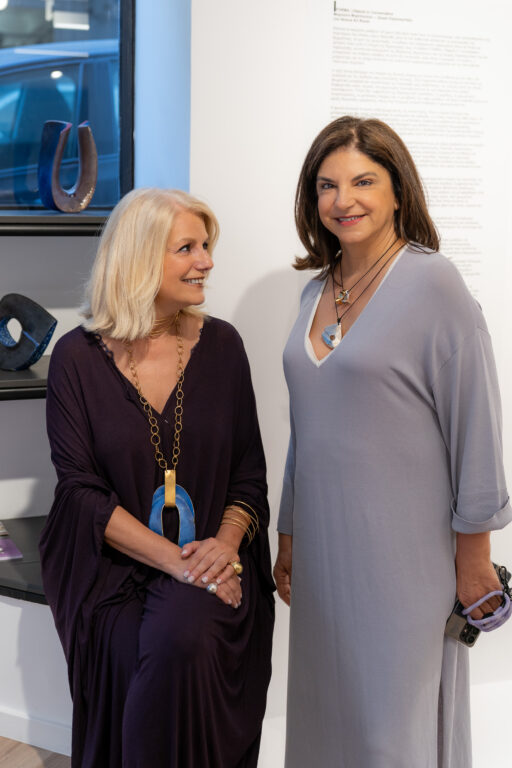
I have known Marilena Michopoulou for very many years; in fact, recently, I have been working with clay under her guidance. The deep appreciation I hold for her work, as well as for her as a person, made me agree to the proposal and the idea of this collaboration. I had some works in progress, knowing some of the works she was preparing, and the whole thing just unfolded quite naturally! Forma, as a title, encapsulates this endeavor of shifting scale and function, since each of us approached, in our own way, our respective forms transitioning from sculpture to jewelry.
Having participated in numerous collaborations and collective actions, what do you believe makes a collaboration meaningful and creative? What are the elements that allow two different voices to coexist without losing their autonomy?
A collaboration becomes meaningful when it is based on mutual trust, a shared vision, and respect for the other’s distinctiveness. Two distinct voices coexist autonomously when one does not attempt to overshadow the other, but rather, they function like clay and metal: they unite in a common work while maintaining their unique properties and qualities intact. Creativity is ignited when communication remains open, egos recede, and the process turns into a living dialogue, where the final result is greater than the sum of its parts.
Thank you!
