Niki Stylianou speaks to René Sarantinou from Top Magazine
Her vision, design, and the support of creators.
21 July 2026
Niki Stylianou has dedicated her journey to creating spaces where art becomes a catalyst for dialogue, collaboration, and genuine human connection. Prompted by her work through the UNI.VERSUS Art Room, the JELO6 Project, and The Light Factory, she discusses the value of authentic expression, creativity, and the exchange of ideas within the contemporary art scene.
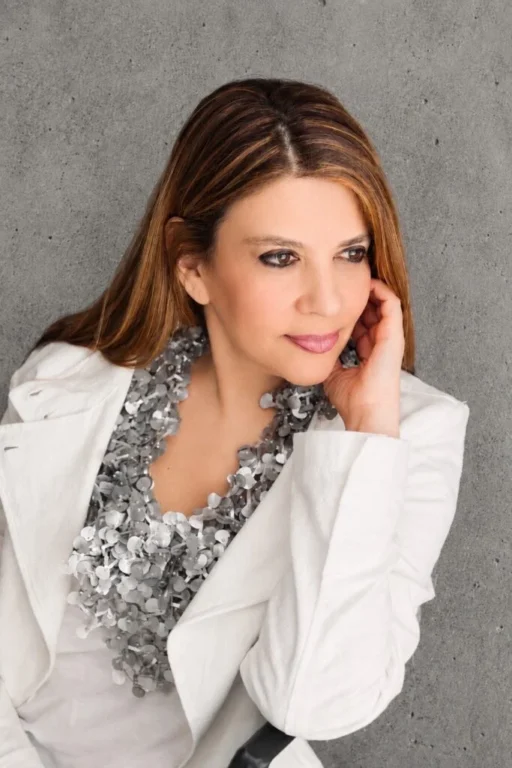
How was the idea of the UNI.VERSUS Art Room born, and what was your personal vision when you embarked on this endeavor?
I love people, life, self-expression, creation, and creativity.
The UNI.VERSUS Art Room was born at a time when the need for free expression became a priority in my life. From the very beginning, I envisioned it not as a conventional gallery, but as a space for encounters, exchange, and conversation.
Perhaps this approach is rooted in my architectural background. I have always been interested not only in beautiful objects and environments, but also in the relationships that develop between them. I am fascinated by systems, interactions, and dynamics: between the viewer and the artwork; between the artwork and posture, movement, and the body; and between an idea and the process of bringing it to life.
Over the years, UNI.VERSUS has evolved into an open platform for dialogue, collaboration, and experimentation. My aim is to create conditions that empower artists—offering them a safe space in which to exhibit their work, connect meaningfully with themselves, and engage with the public.
I believe that authentic artistic expression, whether through fine or applied art, possesses immense power. Authenticity has the remarkable ability to touch us both individually and collectively, bringing us together through shared experience.
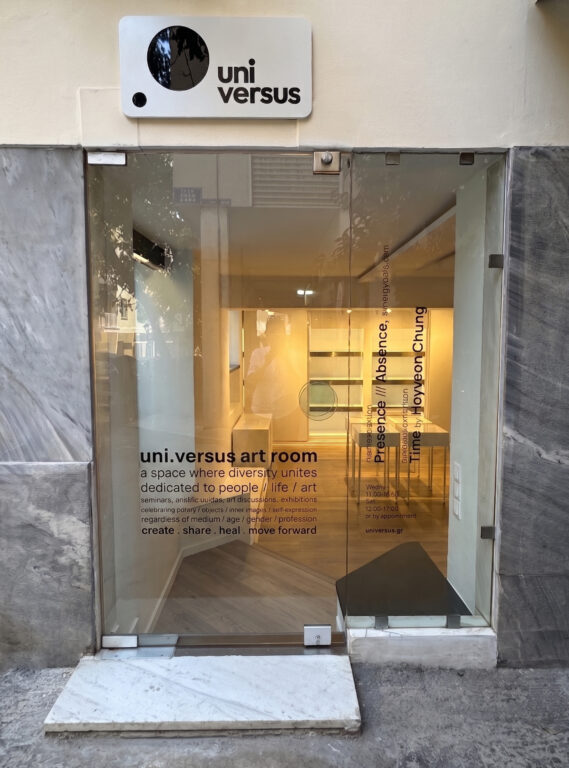
The gallery navigates between contemporary art, design, and art jewelry, hosting various forms of creative expression. What is it that connects all these practices under the same roof?
I consciously choose not to view contemporary art, craftsmanship, design, and art jewelry as separate fields. I see them as different languages within the same creative process.
What moves me is not so much the final form or medium, but the relationship between human beings and materiality—the moment when an idea takes shape and a material, whether pigment, clay, metal, wood, fabric, or even plastic, is transformed into a carrier of meaning.
Every work retains traces of the journey that brought it into being and becomes the bearer of its own narrative.
In its current form, UNI.VERSUS does not represent a specific discipline. Instead, it celebrates the creative process itself, regardless of the medium through which it is expressed.
When jewelry meets sculpture, when a functional object enters into dialogue with a work of visual art, or when design touches art, their differences are not erased. On the contrary, they become more compelling. At these intersections, new interpretations, collaborations, and ways of perceiving both the works and ourselves can emerge.
I believe contemporary creation does not need rigid boundaries. It needs open environments where ideas, materials, and people can meet, interact, and evolve together.
This is the kind of space UNI.VERSUS aspires to be.

Brooch by Artemis Valsamaki
How do you select the artists and the exhibitions you present? Is there a specific curatorial philosophy that characterizes the UNI.VERSUS Art Room?
The curatorial philosophy of UNI.VERSUS is centred more on creating connections than on presenting objects. We bring together creators from different disciplines, generations, and cultural backgrounds whenever we sense that they share a common conceptual core—one that can meaningfully illuminate questions and ideas that remain open to exploration.
Personally, I do not consider myself a curator in the traditional sense. I see my role as accompanying people on their creative journeys and seeking out those who have the courage to investigate, question, and express something genuinely their own.
This is why I would describe UNI.VERSUS as a human-centred platform.
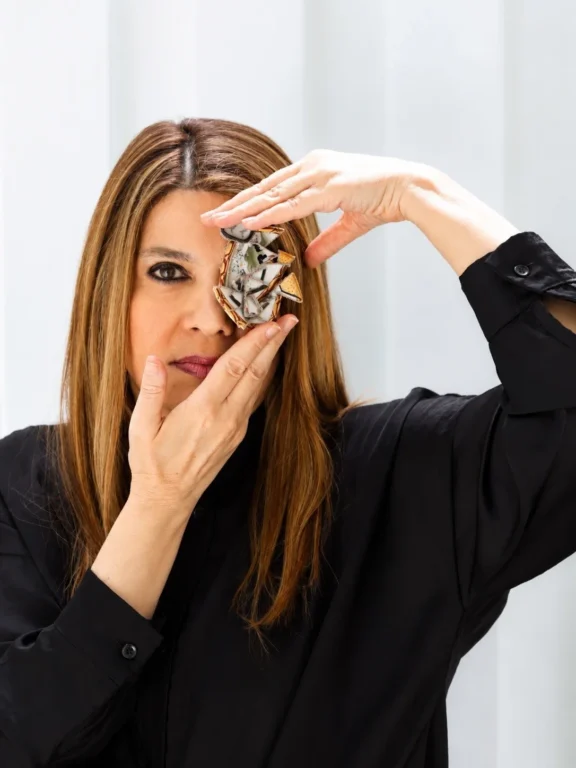
Brooch by Liana Pattihis
Your activity extends beyond Greece, through collaborations and participation in international events. How important is it for you to act as a bridge between Greek creation and the international audience?
I consider international collaboration essential, but not as a form of one-dimensional promotion. I do not believe that culture is “exported.” I believe it must travel.
International collaborations are necessary not only for artworks to travel, but, more importantly, for ideas to travel. Meaningful exchange begins when people, cultures, and ways of thinking meet on equal terms—when they create space to learn from and influence one another and, if they choose, to absorb new perspectives and evolve through this creative exchange.
Through UNI.VERSUS, I strive to build bridges that work in both directions: to give Greek creators opportunities to engage with the world, while also bringing artists, ideas, experiences, and practices to Greece that can enrich our own creative community.
I believe deeply in the power of exchange. The more we listen, share, and collaborate, the broader our horizons become.
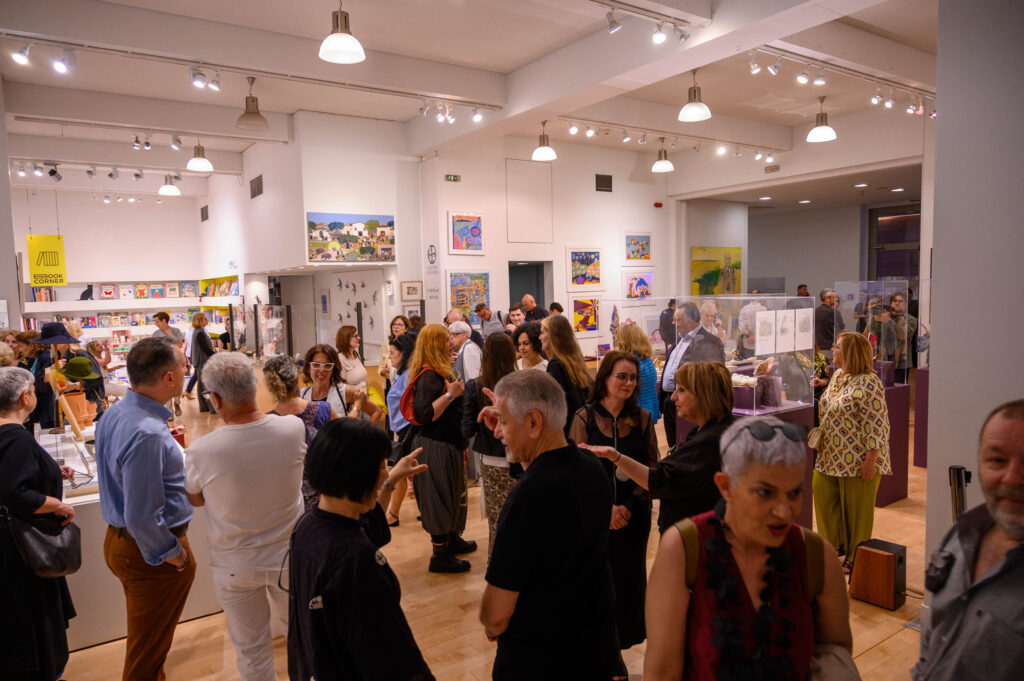
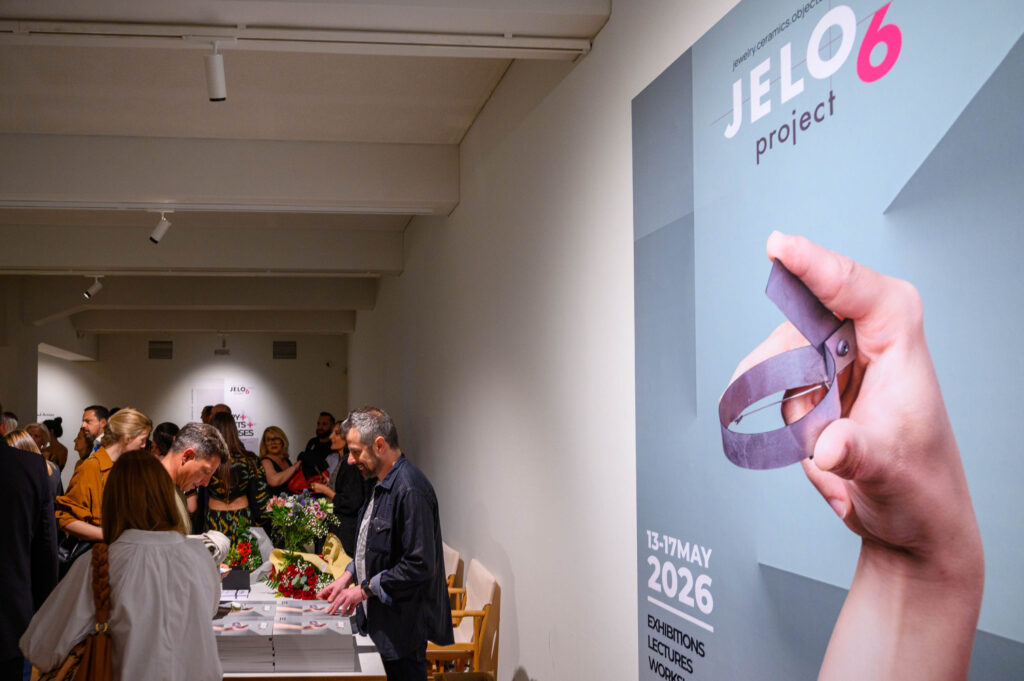
In addition to the UNI.VERSUS Art Room, you are a co-organizer of the JELO6 Project, an initiative that has significantly contributed to the promotion of contemporary art jewelry in Greece. How do you see the institution evolving, and what is its role in shaping a more outward-looking Greek creative community?
The JELO6 Project was born from the need to create a shared meeting ground for people working with jewellery, ceramics, micro-sculpture, and objects as vehicles for artistic expression. From the outset, our aim was not simply to establish another event, but to build a vibrant creative community.
As this community continues to grow, we remain committed to the same values: connection and collaboration among Greek and international creators, inclusivity, participation, and the belief that creativity can be a meaningful form of peaceful activism.
Art does more than document or critique. It can give form to our concerns, open new ways of thinking, and create space for meaningful communication.
For this reason, I believe the greatest value of JELO6 lies not in the number of participants or the extent of its international visibility, but in the relationships it creates—relationships that continue to develop long after each event has ended. When people meet, a collaboration begins, a joint exhibition takes shape, or a new idea finds fertile ground in which to grow, I feel that JELO6 has truly fulfilled its purpose.
I hope JELO6 will continue to serve as an open space for connection and exchange—one in which Greek creativity engages with the international scene on equal terms, and diversity is not diminished or erased, but recognised as the greatest strength of any living creative community.
Through The Light Factory, you focus on supporting and empowering artists through mentoring and consulting. What are the greatest challenges creators face today, and what do you aim to offer them through this initiative?
Today, creators are called upon to balance many different roles. It is no longer enough to be highly skilled in their discipline. They must communicate their work, shape their professional path, manage collaborations, find their audience, continue to evolve, and build an international presence—all without sacrificing the time and inner space that creativity itself requires.
Maintaining this balance is not easy. Yet I believe the greatest challenge is not practical; it is remaining connected to the reason one began creating in the first place. Amid the noise of everyday life and the pressure of constant visibility, it is easy to lose one’s personal voice while trying to meet external demands, expectations, and conditions.
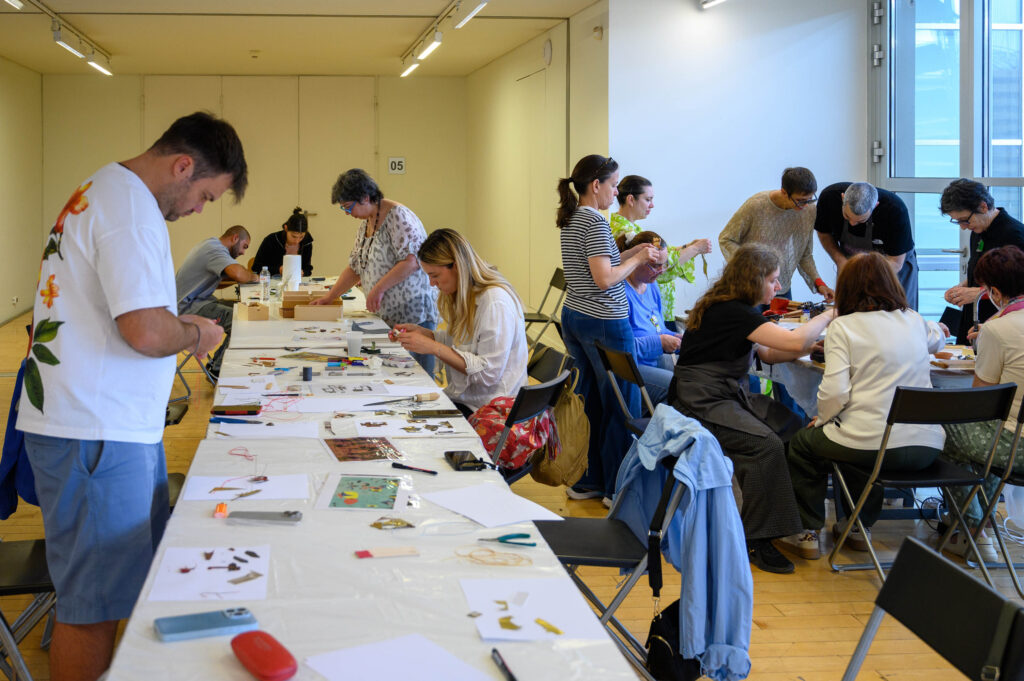
The Light Factory was created precisely to support creators on this journey. We approach mentoring not as a one-way transfer of knowledge, but as a creative dialogue—one that helps each artist recognise their potential, organise their next steps, and develop greater confidence in their unique perspective.
For me, meaningful support is not about providing ready-made answers. It is about creating the right conditions and offering the appropriate tools so that each person can discover their own answers.
When creators find their voice and feel able to express it with consistency and freedom, they have already taken the most important step.
Originally published in: https://topmagazin.gr/
